
Table of Contents
- How to Tell If Skincare Is Working: The First 30 Days
- Signs of Effective Botanical Skincare Products
- How Long for Skincare to Show Results
- Signs of Skin Purging vs Reaction
- How to Identify High-Quality Botanical Formulations
- Botanical-Drug Interactions and Skin Sensitivity
- Frequently Asked Questions
Last Updated: September 20, 2026
How to Tell If Skincare Is Working: The First 30 Days
Most people abandon a new botanical skincare routine too early — right before it starts working. According to American Academy of Dermatology guidance on skincare timelines, skin cell turnover takes roughly four weeks, which means judging a product before day 30 tells you almost nothing about whether it’s working.
Botanical skincare works with your skin’s biology, not against it. That means the first two weeks often look like nothing is happening — no dramatic change, no purge, just quiet underlying repair. By week four, the signals become clear. The guide below covers exactly what to look for, how to read those signals, and how to spot the difference between a product that’s working and one that’s quietly irritating your skin.
Signs of Effective Botanical Skincare Products
The clearest sign of effective botanical skincare is a calm, comfortable, progressively better-hydrated complexion over 4–6 weeks. No sudden miracles, no irritation — just steady, cumulative progress you can see and feel. The signals below are what to watch for, in the order they typically appear.
- Softness you can feel within the first week
- Fewer dry, flaky patches by week two
- A more even, rested look by week four
- Makeup sitting smoother on the skin surface
- Less redness after cleansing
- No stinging or tightness after application
If your skin feels calm and looks incrementally better each week, the formula is working. The most common mistake is expecting dramatic visible change in the first two weeks and switching products before the barrier has had enough time to respond.
Hydration and Skin Barrier Support
A healthy skin barrier retains water and blocks environmental irritants. When it’s functioning well, skin feels consistently plump and comfortable throughout the day — not tight after washing, not reactive after product application.
Botanical ingredients like jojoba, squalane, and shea butter closely mimic the skin’s own lipid composition, supporting the barrier’s ability to repair itself. Confirm it’s working when:
- Skin stays soft for several hours after moisturizing — not just immediately after
- Flaking around the nose and cheeks reduces without manual exfoliation
- Post-cleansing redness fades faster than it did in week one
- Products that previously stung on application now absorb without discomfort
If hydration improves but irritation doesn’t resolve, the formula may be too concentrated for your skin’s current sensitivity level. That’s a signal to simplify — not to add more products. For reactive skin, switching to a barrier-first formula like the Blue Beauty Cream — built with grass-fed tallow, blue tansy, and probiotics — addresses the barrier and the inflammation simultaneously.
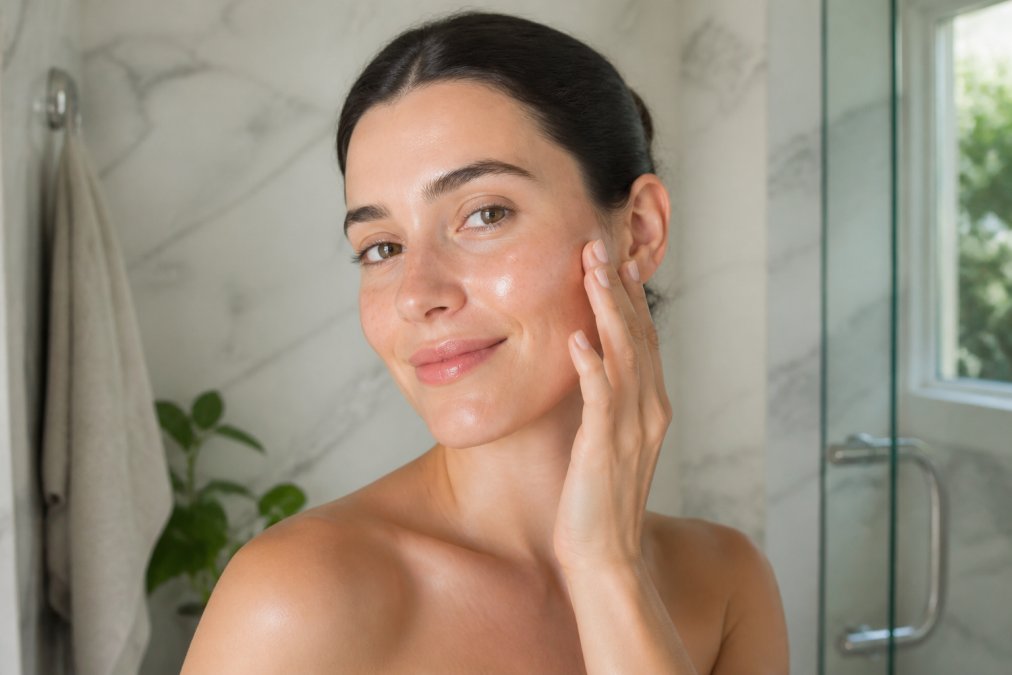
Texture Improvement and Skin Tone
Texture and tone shifts are slower signals, but they’re the most reliable long-term indicators that active ingredients are working at the right concentration. Collagen synthesis and accelerated cell renewal take weeks to produce visible surface change — expect meaningful improvement around weeks six to eight, not before.
Look for:
- Smoother, more refined skin texture under direct light
- Fine lines looking softer — less defined, not erased
- A more even skin tone across the cheeks, forehead, and chin
- Fewer visible dry patches without requiring extra product
- A natural, non-greasy glow — luminosity, not shine
A practical way to track texture change: take a close-up photo in the same lighting each Sunday morning before applying any product. Side-by-side comparison over six weeks makes gradual improvement visible in a way that daily observation misses.
How Long for Skincare to Show Results
Most botanical skincare shows visible results in 4–6 weeks, with deeper changes in texture and tone appearing between weeks 8 and 12. Hydration and comfort improve fastest; collagen synthesis and tone evenness take the longest because they depend on full cellular turnover cycles.
| Timeframe | What You’ll Notice | What’s Happening |
|---|---|---|
| Week 1–2 | Softer feel, less tightness | Surface hydration improves |
| Week 4 | Better hydration, calmer skin | Barrier begins repairing |
| Week 6–8 | Smoother texture | Cell turnover accelerates |
| Week 8–12 | More even tone, softer lines | Collagen synthesis responds |
The 4-2-4 Rule in Skincare
The 4-2-4 rule is a practical framework for evaluating new products without abandoning them prematurely. Give a product 4 weeks to assess hydration and comfort, 2 weeks to confirm it isn’t causing irritation or breakouts, and 4 more weeks to evaluate texture and tone change.
- Weeks 1–4: Judge hydration and comfort only
- Weeks 5–6: Confirm no irritation or new breakouts
- Weeks 7–10: Assess texture and tone shifts
Signs of Skin Purging vs Reaction
Purging and a reaction look similar at a glance but require opposite responses — purging resolves on its own; a reaction requires stopping the product. The distinction is in the location, timing, and symptom type.
| Purging | Reaction | |
|---|---|---|
| Location | Areas you normally break out | New areas; often spreading |
| Appearance | Small bumps, comedones clearing | Redness, hives, or contact rash |
| Sensation | No pain; congestion clearing | Stinging, burning, or swelling |
| Timeline | Resolves in 2–4 weeks | Worsens or persists |
| Response | Continue; monitor | Stop product immediately |
How to Identify High-Quality Botanical Formulations
High-quality botanical formulations list active ingredients clearly, use standardized extracts, and avoid hiding behind vague “natural” claims. The ingredient list tells you more than the marketing copy — knowing what to look for makes the difference between a well-formulated product and an expensive botanical-scented moisturizer.
Reading a Label for Potency: The Four Markers
1. Named extract with plant part. “Calendula officinalis flower extract” tells you the species and the specific plant part used. “Botanical blend” tells you nothing. Different plant parts contain different compound profiles — the flower, root, seed, and leaf of the same plant produce different active concentrations, so the part matters for predicting efficacy.
2. Ingredient list position. Cosmetic ingredients are listed in descending order of concentration. A botanical extract listed in the final quarter of a long ingredient list is present at a trace level — enough to appear on the label, not enough to produce a clinical effect. For a botanical active to perform, it should appear in the first half of the list, ideally within the top ten ingredients.
3. Preservative system transparency. Every water-based formula requires preservation. A label that lists its preservative system clearly — phenoxyethanol, sodium benzoate, potassium sorbate — is more trustworthy than one with no visible preservative, which suggests either an unstable formula or a hidden ingredient. Knowing the preservative also lets you cross-reference against known irritants for sensitive skin.
4. pH disclosure or formulation context. Botanical actives like vitamin C derivatives, AHA exfoliants, and enzyme extracts only perform within specific pH ranges. A brand that discloses pH — or explains formulation context (e.g., “optimized for delivery at pH 3.5”) — is communicating that they understand the chemistry behind their claims. Absence of any pH context on an acid-based botanical formula is a red flag.
Standardized Extracts and Potency
Standardized extracts guarantee a consistent concentration of active compounds across every production batch. Without standardization, two bottles of the same product can vary significantly in potency — which is why published clinical results often don’t match consumer experience. The Anua Azelaic Acid Serum is a clear example: it discloses the active percentage (10% azelaic acid) explicitly, allowing you to evaluate concentration rather than rely on marketing language.
Sustainability vs. Efficacy Trade-offs
A less-discussed quality marker is the tension between eco-friendly sourcing and clinical stability. Cold-pressed, unrefined botanical oils retain more phytonutrients but oxidize faster, shortening shelf life and reducing potency over time. Refined oils are more stable but lose some beneficial compounds in processing.
- Packaging: Airless pumps and opaque bottles protect oxidation-prone oils better than clear glass droppers or open jars.
- Shelf life: A shorter stated shelf life on an unrefined oil is a sign of honesty, not weakness — it means the formula hasn’t been over-stabilized at the expense of efficacy.
- Sourcing: Regenerative or organic sourcing affects environmental impact but does not guarantee higher potency. Ask for standardization data, not just a sustainability claim.
Botanical-Drug Interactions and Skin Sensitivity
Botanical ingredients can interact with prescription skincare and systemic medications, especially retinoids, topical acids, and blood thinners. The natural origin of an ingredient does not make it pharmacologically inert — several commonly used botanicals have documented biological activity that creates real interaction risk.
How Botanical Actives Interact with Prescription Topicals
There are three main interaction pathways to understand:
- Additive irritation: Botanicals high in naturally occurring acids — citrus extracts, papaya enzymes, willow bark — stack exfoliation load on top of prescription retinoids or alpha-hydroxy acids. The combined effect overwhelms the barrier, producing redness, stinging, and flaking that resembles a reaction but is actually cumulative irritation from two separately tolerable actives used together.
- Absorption enhancement: Some botanical oils and terpenes temporarily increase skin permeability, which can push a prescription active deeper than intended and raise the risk of irritation or systemic absorption. This is a documented concern with eucalyptus, peppermint, and menthol-heavy formulas.
- Pharmacological overlap: Certain botanicals contain compounds with their own biological activity. Willow bark contains salicin, a salicylate precursor (pubmed.ncbi.nlm.nih.gov). Licorice root contains glabridin, which affects pigmentation pathways. Ginkgo and high-dose garlic can influence platelet function — relevant if you take anticoagulants.
A Practical Sequencing Framework
Rather than avoiding botanicals entirely alongside prescriptions, most practitioners recommend sequencing them to minimize overlap:
- Morning: Antioxidant botanicals (green tea, kakadu plum vitamin C, ferulic acid) pair well with sunscreen and support daytime environmental defense without competing with prescription actives.
- Evening: Apply prescription retinoids or acids first, wait 10–20 minutes for pH to normalize, then follow with a bland botanical-light moisturizer. Reserve active botanical serums for evenings when you skip the prescription.
- Alternate nights: If your skin is reactive, rotate prescription actives and botanical exfoliants on separate evenings rather than layering them on the same night.
When to Stop and Call a Professional
- Unusual bruising or prolonged bleeding while using botanical oils alongside anticoagulants
- Worsening irritation that does not improve within 3–5 days of stopping the botanical product
- New or worsening pigmentation changes while using licorice root, citrus extracts, or botanical brighteners alongside prescription lightening treatments
For sensitive or reactive skin navigating this complexity, a soothing barrier-first formula reduces the baseline reactivity that makes interactions worse. The Blue Beauty Cream Soothing Tallow Face Cream uses grass-fed tallow, blue tansy, and a probiotic blend to calm redness and reinforce barrier function — without actives that compete with prescription treatments.

Frequently Asked Questions
How can you tell if a botanical skincare product is going to be effective?
Look for standardized extracts with listed percentages of active compounds, not just the botanical name. Effective botanical skincare products also list preservative systems that protect formulation stability and disclose where botanical actives appear in the ingredient list — ideally in the first half. If a label says “botanical blend” without specifics, the potency is likely too low to deliver visible results. Patch testing before full use helps confirm your skin tolerates the active ingredients.
How long does it take for botanical skincare to show visible results?
Most botanical skincare products need 4 to 12 weeks for visible changes. Hydration and skin barrier improvements appear within the first two weeks. Texture improvement, skin tone evenness, and collagen synthesis changes take longer because they depend on cellular turnover. The 4-2-4 rule helps set expectations: four weeks for hydration, two weeks to confirm no irritation, four weeks for texture and tone. If you see no change after 12 weeks, the formulation may not suit your skin’s sensitivity or specific concerns.
What are the signs of skin purging vs reaction when starting botanical products?
Skin purging causes small bumps and breakouts in areas you normally break out, resolving within four to six weeks as cellular turnover accelerates. A reaction causes redness, itching, burning, or contact dermatitis spreading to new areas — it worsens rather than resolves. Purging is an expected phase with exfoliating actives; a reaction signals inflammation or an allergy. Patch testing on your inner arm before applying to your face helps distinguish the two before committing to full use.
How do you distinguish between marketing claims and effective botanical ingredients?
Check the ingredient list for standardized extracts with specific compound percentages, and verify that botanical actives appear in the first half of the formula — not at the tail end where concentrations are cosmetic rather than clinical. Effective botanical skincare products disclose preservative systems and, where relevant, pH context. Avoid products that list botanical extracts last and rely on marketing language like “natural” or “plant-powered” as substitutes for formulation transparency.
Building a botanical routine that delivers visible results takes patience, the right formulas, and a clear framework for knowing what’s working. The signals above give you a structured way to evaluate progress — without switching too early or staying with a product that isn’t performing.
Experience considered care for sensitive skin. Enjoy 15% off your first protocol with code FAWN15.